
A practical breakdown of the two mindset errors that trip up traders again and again — whether you trade by hand, run an algorithm, or both.
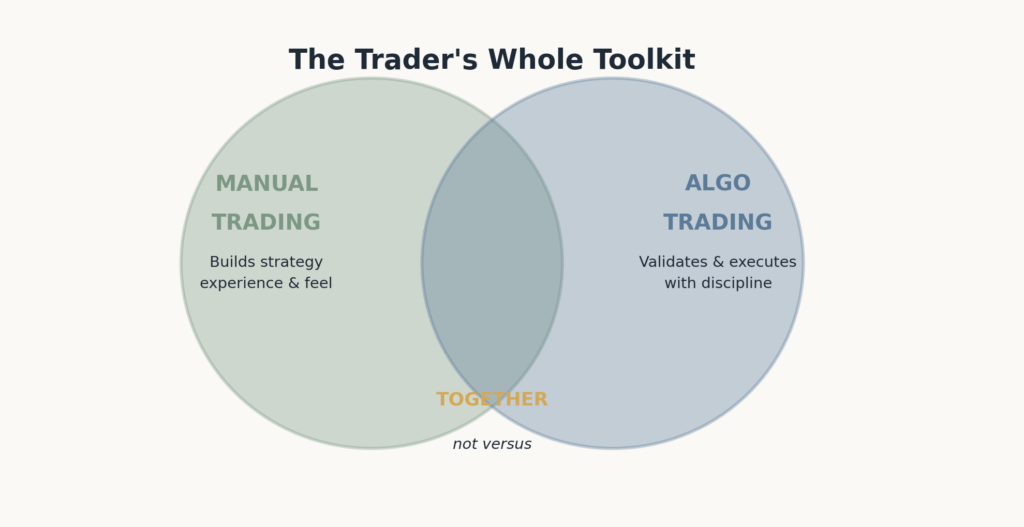
The right mental model isn’t Algo vs. Manual — it’s Algo + Manual.
Every trader eventually asks the same question: should I trade manually, or should I build an algorithm? It sounds like a fork in the road — but that framing is itself the first mistake. Below are the two errors that show up again and again, in algo trading and manual trading alike, along with simple, actionable fixes for each.
MISTAKE 01
Treating Algo and Manual Trading as Rivals
The most common mistake traders make is turning this into a competition — “Is algo trading better, or is manual trading better?” It’s a bit like asking whether the heart is “bigger” than the brain. There’s no winner, because they aren’t meant to replace each other. They’re meant to work together.

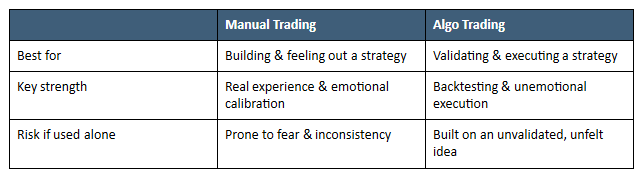
Each brings something the other simply cannot supply on its own.
Manual Trading — Gives you real experience
- How the strategy behaves in live conditions
- What fear feels like when a trade moves against you
- How to book profit and manage exits
- How to place and trail a stop-loss
- What your account genuinely looks like after months of trading it
Algo Trading — Gives you validation & discipline
- Back-tests the idea across years of data
- Proves or disproves the strategy with evidence
- Removes fear-based hesitation on entries
- Removes premature stop-loss widening
- Executes the plan with 100% consistency
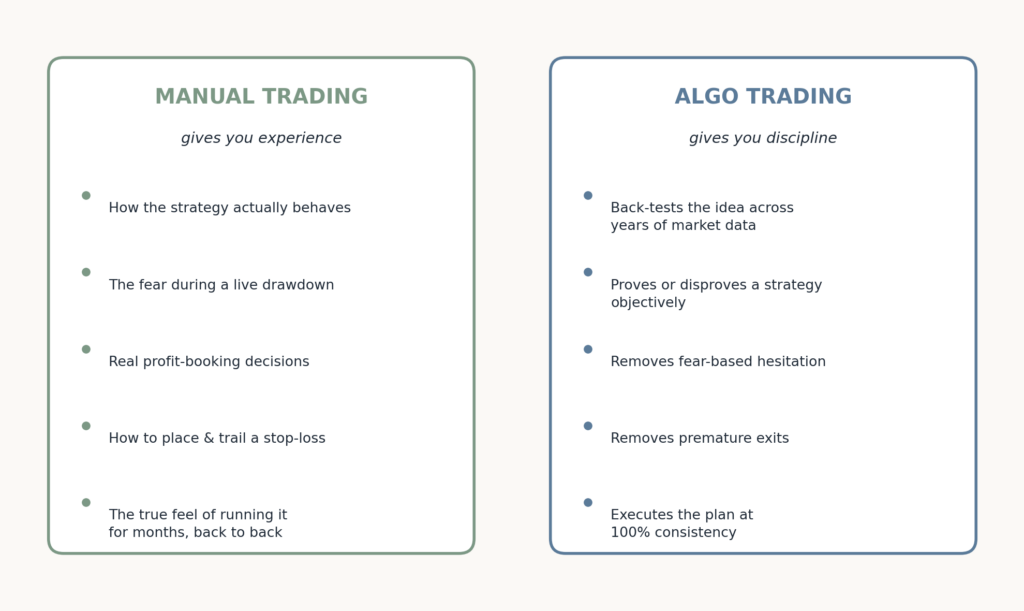
Two different jobs, done by two different tools — and a serious trader eventually needs both.
The Takeaway
Why can’t an algo just replace manual trading entirely?
Because an algorithm only executes what it’s told — it has no sense of whether the underlying strategy is actually sound in the way the market currently behaves. Manual trading is where that judgment and feel comes from. Skipping it means automating an idea you’ve never truly tested by hand.
Even experienced algo traders should still trade manually?
Yes. Manual reps build the intuition to know when a strategy is behaving normally versus when something has genuinely changed in the market — a judgment call no backtest fully replaces.
MISTAKE 02
Chasing the "One Big Trade" Instead of Consistency
The second mistake is emotional rather than technical, and almost every trader falls into it at some point: the desire for one massive, life-changing trade — the “zero to hero” fantasy where a single trade changes everything.
Wanting to catch a genuinely big move isn’t wrong. You should be able to catch big trades when they come. But that ambition should never outrank something far more important.
Consistency matters more than risk-to-reward. Your win rate matters more than your reward ratio.
Why a "Good-Looking" Ratio Can Be Misleading
Say you take a ₹5 stop-loss and set a ₹15 target. On paper, that’s a clean 1:3 risk-to-reward ratio — and it looks impressive. But the ratio alone doesn’t tell the full story. Probability does.

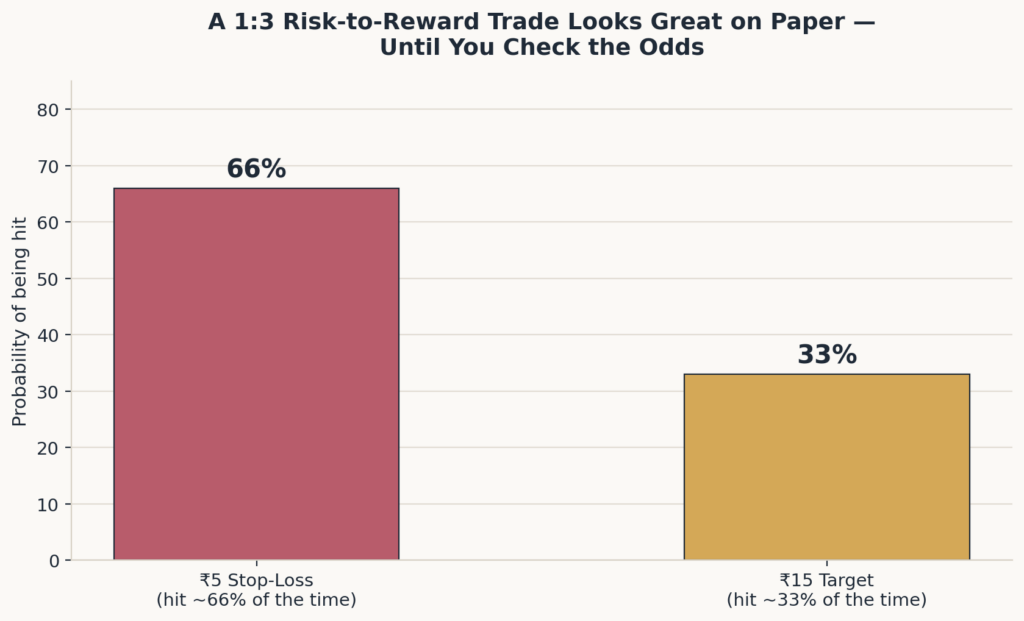
A 1:3 risk-to-reward setup can still drift toward breakeven once you weigh in probability.

So What Should You Prioritize?
- Consistency first — winning 60%, 70%, even 80% of your trades.
- Risk-to-reward second — a favorable ratio matters, but not more than staying consistently profitable.
Consider the alternative: a genuinely inconsistent pattern where, out of 100 trades, only 12 actually work out. Loss, loss, loss, loss — a big win — then loss, loss, loss, loss, loss, loss, another big win. That rhythm makes it almost impossible to ever build real momentum or a growing account.

The Mango Sapling Principle
Imagine your trading account as a small mango sapling. You wouldn’t expect — or want — it to shoot up overnight and again the next day. That’s not healthy growth, that’s closer to gambling. What you want is for it to grow a little every single day: small, steady, and consistent.
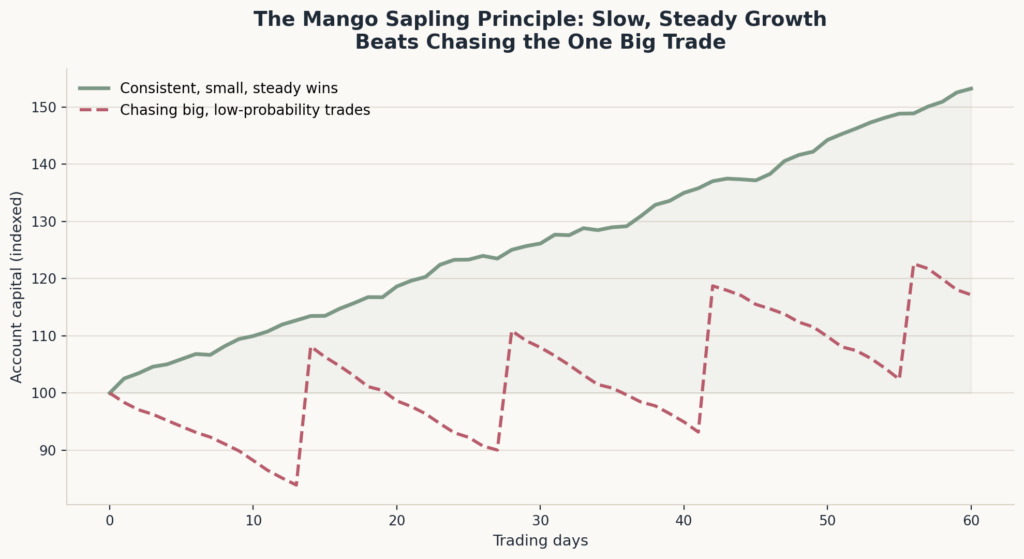
Slow and steady compounding (sage) reliably outpaces a volatile, big-win-chasing account curve (rose) over time
QUICK FIX
One Simple Rule for a Higher Win Rate
There’s one concrete tweak that can immediately raise your win rate, depending on which side of the options trade you’re on.
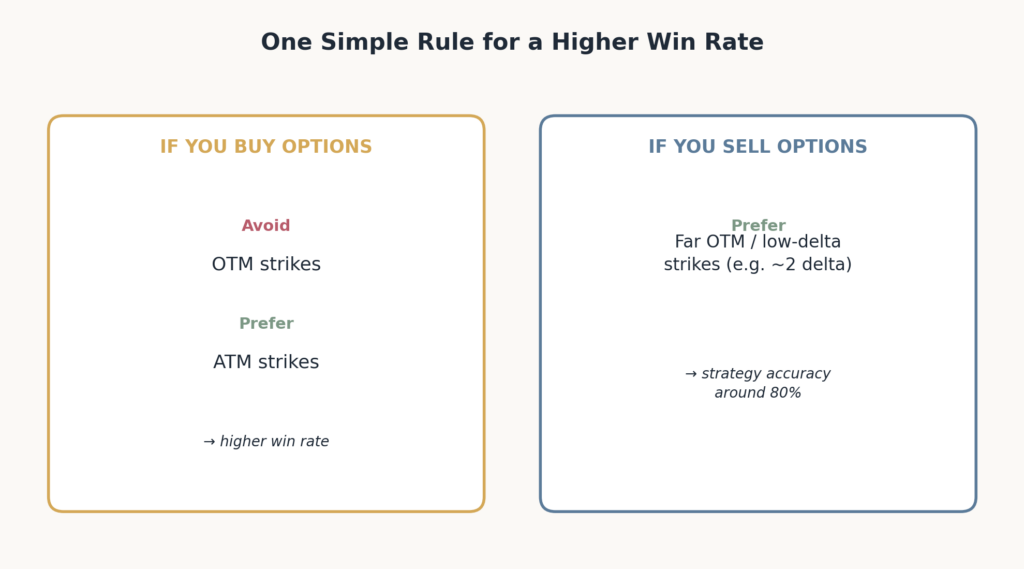
Buyers lean ATM for a higher win rate. Sellers lean far OTM, chosen by delta.
If you’re buying options
Avoid trading far Out-of-The-Money (OTM) strikes. Trade At-The-Money (ATM) instead — ATM strikes give you a meaningfully higher win rate than cheaper, further OTM strikes.
If you’re selling options
Sell based on delta, not just premium. Selling a strike around the 2-delta mark, for example, can push your strategy’s accuracy to roughly 80%.

SUMMARY
The Two Fixes to Remember
01 — Stop treating algo vs. manual as a competition
Think algo + manual. Manual trading builds real strategy experience; algo trading backtests that strategy and executes it with total discipline. Use both.
02 — Stop chasing the “hero” trade
Prioritize a high win rate over an impressive-looking risk-to-reward ratio. Aim for small, steady, compounding profits — like a sapling growing a little every day — rather than gambling on the big score.
If you’re trading manually, remember there’s an entirely different world called algo trading — with its own strengths — that can help you. And if you’re already running an algorithm, don’t skip the manual experience; you still need to feel the strategy completely before trusting a machine to run it for you.
Small, consistent, “green” days — repeated patiently — build far more durable wealth than any single spectacular trade ever will.